


The world constantly needs innovation. Indeed, innovation doesn’t end with the discovery of fire, the development of the first vaccine, the design of the steam engine, the advent of the internet, or the deployment of artificial intelligence. The more we evolve, the more we will need new technologies. In this respect, scientific research and high-tech institutions are of paramount importance not only from an economic perspective, but also in general, in our lives.
To deliver innovation and technological advancements, scientific research laboratories need the necessary equipment and logistics. Attention all high-tech companies: discover the 5 essential pieces of laboratory equipment your facility needs.
Laboratory equipment intended for measurement
In industrial, professional, and private settings, measuring instruments are essential for obtaining reliable data. Numerous experiments and research conducted in science, physics, and chemistry contribute significantly to the development of current technology. Therefore, here is a comprehensive list of laboratory equipment designed for measurement.
The different types of scales
Three types of balances must be present in a laboratory to ensure maximum research and experimentation.
- A beam balance is primarily used for the analysis and comparison of several quantities or masses. It is also called a digital balance.
- A balance scale is used to weigh various objects. On the first pan, you place the object to be weighed and on the second, one or more marked weights.
- Electronic scales allow for the weighing and verification of certain masses in various fields. In medicine, electronic scales are used to determine patients’ weights.
The cruet
A burette is one of the instruments used in a research laboratory. It is generally graduated and consists of calibrated tubes. Two types of burettes should be part of your laboratory equipment: the titration burette and the gas burette. This type of device is most often used to add reagents to a chemical composition or to perform a titration. The use of the burette largely allows for the precise measurement of volumetric titrations. As one of the essential instruments in a chemistry laboratory, the burette is available in two sizes: 250 ml and 50 ml. The graduations range from 0.05 ml to 0.1 ml.

The dynamometer
This laboratory equipment allows for the measurement of force or torque using a spring. Laboratories and research and quality departments all have a dynamometer. This mechanical device consists of a measuring cursor, graduations, and a hook for holding the object to be measured. Furthermore, there are two types of dynamometers: mechanical and digital. The latter is portable and includes a force sensor, an electronic circuit board, software, and a display. Its uses are numerous and varied: from checking gas cartridges in industry to measuring the concentration of certain substances in a laboratory.
Electrical instruments
This laboratory equipment allows for the efficient measurement of current and voltage. It is particularly useful for supplying the laboratory with electricity. Furthermore, you can use it to confirm or refute experimental results. Here are some examples of electrical equipment for your laboratory.
Capacitor
This electronic component is used for:
- To provide stability to the power supply during a voltage drop or increase
- The processing of certain periodic signals such as filtering
- Ensure the separation of direct current and alternating current, taking into account that the former is slowed down by the capacitor.
- Setting up the energy storage system needed for your laboratory
Composed of two conductive plates or electrodes, its main function is to store electrical charges.
Power source or power supply
The power supply is an essential component in an electrical circuit. Its primary function is to provide the necessary energy for optimal current flow. This allows electrons to move easily through the electrical conductor. Two types of current enable the flow of electrons through the wires and components of the circuit:
- Direct current ensures a unidirectional movement of electrons. These leave the positive terminal of the power supply and move towards the negative terminal.
- Alternating current, on the other hand, allows for bidirectional movement of electrons. Therefore, there can be a change in the current flow at any given moment.
The ammeter and the voltmeter
These are two measuring instruments, each with different functions. While one measures current flow, the other focuses on the voltage between two points in an electrical circuit. Since both devices measure voltage and current, their operation is similar to that of a galvanometer. It is thanks to the coils placed between the magnet that the current can flow through the entire circuit. While the ammeter is connected in series with the circuit, the voltmeter is connected in parallel. This parallel connection allows for the efficient measurement of the potential difference and the voltage in the circuit. For greater accuracy, it is best to use an ammeter.
Laboratory equipment for microscopy
The field of microscopy focuses on the preparation of various samples for subsequent observation. Equipment that meets the needs of scientific research is therefore essential. This effectively ensures the sustainable development of science. Many instruments are required in your laboratory; here are a few examples.
The blades and strips
Slides and coverslips are essential accessories for your microscope. A coverslip is a thin sheet of glass used to cover samples to be analyzed on a microscope slide. The slide itself is the glass plate on which the sample to be analyzed will be placed. These two accessories form an inseparable set that stabilizes each sample you wish to examine under the microscope. Furthermore, for each new specimen to be studied, you will need to place a fragment on the slide and then cover it with the coverslip. Every scientific research laboratory must have this type of microscope accessory to accurately identify various samples.

The magnifying glass
Also classified as an optical instrument, the magnifying glass is the simplest form of the microscope. Because it has a convex lens, its main function is to magnify objects. Three types of magnifying glasses are available:
- The optical magnifying glass works on the principle of the convex lens. The virtual image of an object is therefore magnified and created in front of the lens.
- The digital magnifier is very different from the classic magnifier since it is composed of a vision system and several elements such as a digital camera, a magnification lens for display and acquisition…
- The binocular magnifier, also called a stereo microscope, offers a 3D image, but with low magnification.
The microscope
This is a technique used in imaging to observe objects and see specimens of small dimensions or those invisible to the naked eye. Microscopy is the related field of study. This tool can be found in various laboratories such as science, medicine, or biology labs. There are two different types of microscopes, depending on the scientific discipline:
- An optical microscope is a device that magnifies small images. Equipped with an adjustable light beam, the sample to be analyzed will be well illuminated.
- The electron microscope uses electrostatic and magnetic lenses. It can magnify an image up to two million times. The sample is irradiated by means of an electron beam.
The various containers
A proper laboratory must have containers for storing samples or experimental results. A wide range of containers should therefore be available to all researchers to enable them to conduct new experiments. Here are some examples of containers.
The test tubes
A test tube is a container used to perform certain tests in the field of physics. It allows us to observe how a material reacts to specific stresses or conditions. Widely used in laboratories, four types of test tubes are necessary:
- Test tubes are used to hold small quantities of solutions that will be tested later. These test tubes can be made of glass or plastic.
- Graduated test tubes are used in laboratories to accurately measure the volume of liquid solutions.
- Gas test tubes are made of glass and have a very thick, round base. These can be graduated or ungraduated.
- Vacutainer tubes are most often used during venipuncture. This trademark, registered by Becton-Dickinson, was developed by Joseph Kleiner in 1947.
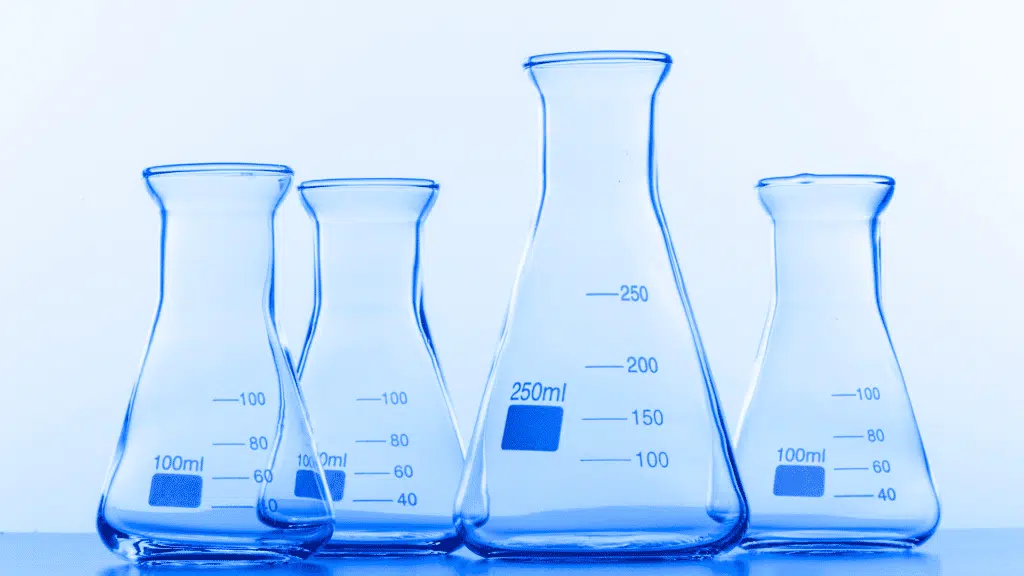
Un erlenmeyer
This is a conical flask, also known as a titration flask. This type of container is primarily used in laboratory glassware. The main characteristic of the Erlenmeyer flask is its conical base and cylindrical neck. It can be sealed with a cork stopper, thus preventing the evaporation of the substances it contains. Its narrow neck helps to limit splashing during chemical reactions. When dealing with liquids that drip slowly during distillation, the Erlenmeyer flask is the most recommended container. It is also essential for exothermic reactions. It also features graduations that allow for the measurement of the liquid’s volume.
A beaker
This container can be used in a laboratory for various applications. Whether in chemistry, physics, or biology, the beaker can be made of plastic or glass. For glass beakers, the capacity varies from 5 ml to 10 liters. As it is a very common piece of laboratory glassware, it is used for stirring, preparing solutions, and even some heating mixtures. It is also used to measure the swelling rate of foam using a density balance. The beaker cannot be sealed airtight because it has a spout. Furthermore, to preserve liquid solutions, cling film or a watch glass can be used.
Laboratory equipment for optimal safety
Preventing workplace accidents is the primary and major purpose of personal protective equipment. During laboratory experiments, researchers and scientists must wear certain types of equipment. Here are a few examples.
Protective gloves
Protective gloves used in a laboratory must meet certain standards. They are either single-use when there is a risk of exposure to chemicals, or reusable in case the hands are immersed in chemicals. The design, heat and chemical resistance, and comfort provided by these gloves are governed by standards EN 420, 374, and 407. Various materials can be used to manufacture protective gloves: latex, nitrile, leather, cotton, neoprene, PVC, or vinyl. Protective gloves are available in different sizes and colors. It is also possible to choose between starch-coated and powder-free gloves.
The laboratory fume hood
This device was specifically designed to extract toxic fumes that may escape from various experiments. Its primary function is to ensure the safety of scientists in the laboratory. Shaped like a funnel, it is equipped with a filtration system that allows air to be expelled through simple natural negative pressure. Since the fume hood is also equipped with a fan, the air is extracted regularly. It is generally placed above distillation equipment or the workstation. There are two types of fume hoods: activated carbon filtration hoods and fume hoods with external extraction.
Safety glasses, essential protective equipment
Some substances can be highly toxic and harmful to the eyes. Very different from regular prescription glasses, these protective or safety glasses are made of highly resistant plastic. Here are three types of safety glasses you can wear depending on your activity:
- Anti-fog protective glasses with UV filters. Most often, these anti-fog glasses are found in the medical field.
- Panoramic and autoclave goggles that are scratch-resistant and excellent anti-fog, suitable for use in a laboratory.
- Disposable goggles that can be used in operating rooms to effectively protect your eyes.