

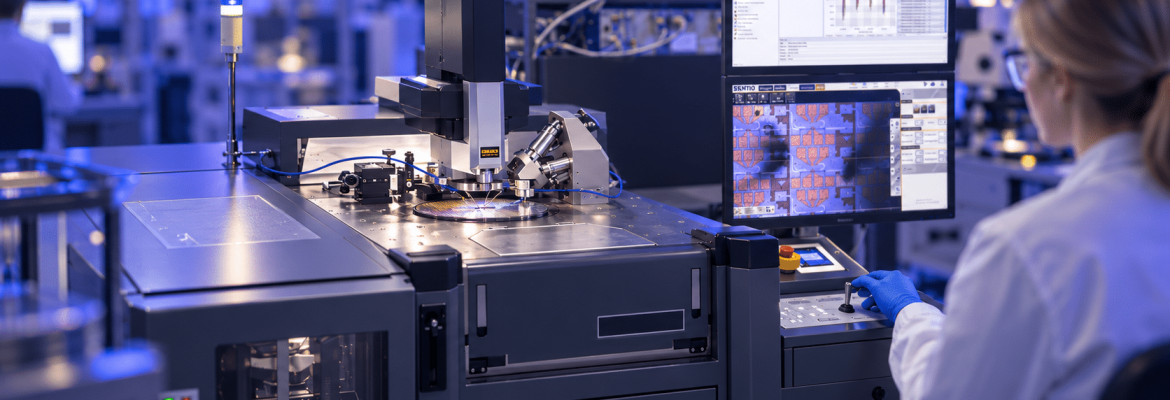
The choice of a probe station is decided less by the spec sheet than by the automation level. Manual, semi-automatic and automatic stations do the same fundamental job, contacting dies on a wafer, but they serve different volumes, budgets and ways of working. This guide describes what each level changes in practice, who it suits, and the questions worth answering before investing. It is written for lab managers, test engineers and deeptech founders who are about to acquire, upgrade or replace probing equipment.
In brief
- Manual stations are the flexible choice for characterization and R&D, semi-automatic stations add motorized stepping and repeatability, automatic stations load and test wafers without an operator
- The decision rests on seven questions, volume and cadence first, then samples, application, precision, temperature, and budget with its upgrade path
- A semi-automatic station that can be upgraded to automatic lets a growing team invest step by step
- New is not the only route, refurbished equipment and rental can open access to probing
Probe station or wafer prober, what these terms cover
The two terms describe the same family of equipment, a system that positions a wafer or a sample and brings its pads into contact with test probes. Usage leans one way or the other, probe station most often designates the laboratory equipment used for characterization, wafer prober the systems oriented toward production, and the boundary is blurred. French-speaking engineers also say station sous pointes. Whatever the name, the machine’s job is the one described in our article on how wafer probing works, holding, positioning and contacting, while the instrument measures.
Manual probe stations
On a manual probe station, the operator does the positioning, one die at a time, under the microscope. That hands-on character is precisely its value. A manual station accepts almost any sample, a full wafer, a diced die, a fragment, a non-standard substrate, and lets the operator change configuration in minutes with the right accessories. It is the natural tool for characterization, process development, debug and failure analysis, at the cost of throughput and operator-dependent repeatability.
Two situations we meet regularly illustrate its place. An industrial site already equipped with automatic probers adds a manual station to characterize individual chips when production tests flag anomalies, the manual station is the investigation bench next to the production flow. And a university laboratory running very specific tests for industrial partners chooses a manual station because its volumes are low, then puts its budget into the specific capabilities that keep the equipment flexible.
Semi-automatic probe stations
A semi-automatic probe station motorizes the movement from die to die and assists the alignment, while the wafer is still loaded by hand. In practice it changes the nature of the work. Stepping through a wafer stops being a test of patience and becomes a programmed sequence, measurements gain the repeatability of motorized positioning, and campaigns over several wafers become realistic for a small team.
This level suits pilot lines, repeated characterization, and laboratories shared between teams. It is the right compromise when cadence rises but does not yet justify a fully automatic station, whose defining feature is the automatic loading of several wafers. It is also the natural choice when a need for statistics appears, testing enough dies to see distributions rather than individual values. One of our customers, a startup testing silicon photonics wafers, chose a semi-automatic station that can be upgraded to automatic, so that the equipment follows the growth of its test cadence and the budget follows the need. That upgrade path is worth checking before purchase on any semi-automatic station.
“Clients rarely regret the capability they bought. They regret the capability they could not add later. Upgradability is the first thing we discuss.”
Automatic probe stations
An automatic probe station loads several wafers automatically, from a cassette or a FOUP for example, aligns them and tests continuously, integrated with the test electronics. It is the production tool, built for volume, availability and consistency, and it removes the operator from the loop for everything except supervision.
Production is not its only home. Automatic stations also serve characterization, and R&D work that chains tests over several wafers, whenever the number of measurements is the point. One industrial laboratory we equip characterizes wafers in RF and millimeter-wave for an internal production customer, on lots sent by the production line, because those high-frequency measurements cannot be carried out downstream. The automatic prober is what makes that volume of RF measurements sustainable.
The three levels side by side
| Manual | Semi-automatic | Automatic | |
|---|---|---|---|
| Throughput | One die at a time, operator paced | Motorized stepping, operator supervised | Continuous, cassette to cassette |
| Repeatability | Depends on the operator | High, assisted alignment | Highest, fully controlled |
| Wafer loading | Manual | Manual | Automatic, cassette or FOUP |
| Typical user | R&D lab, university, failure analysis | Pilot line, scaling startup, shared lab | Production, statistical campaigns |
| Relative cost | € | €€ | €€€ |
| Typical use case | Characterize a prototype, investigate anomalies | Repeated characterization over several wafers | Production lots, chained R&D campaigns over several wafers |
Relative cost is an order of magnitude, the configuration, chuck options and accessories weigh as much as the base machine. See our articles on the wafer chuck and probe cards for what surrounds the station itself.
Seven questions to ask before choosing
- How many dies, per wafer and per day, and at what cadence? Volume is the first separator between the three levels.
- Do you need statistics? Testing enough dies to see distributions calls for motorized stepping at minimum.
- What samples will you put on the chuck? Full wafers only, or dies, fragments and non-standard substrates, which favor manual flexibility.
- What application? DC, RF and millimeter-wave, high power, silicon photonics or low-noise measurements each put their own demands on the station and its environment.
- What precision and repeatability does the measurement require? Operator-dependent positioning may be the limit.
- Do you need to test at temperature? A thermal chuck and temperature conditioning affect the choice of station, and cold brings its own constraints, covered in our article on low-temperature probing.
- What budget, and what growth? If cadence will rise, an upgradable semi-automatic station may beat both a manual station bought twice and an automatic station bought too early.
New, refurbished, or rental
A probe station does not have to be bought new. Refurbished equipment gives access to proven machines at a lower budget, and rental suits time-bounded projects or needs that precede an investment decision. Which route makes sense depends on the equipment and the timeline, and is worth an early conversation.
Whichever route you take, the equipment is only part of the subject. Defining the need, demonstrating the configuration, installing, training the team and maintaining the station, including temperature calibration, are what turn a machine into a working test bench. That accompaniment, from first contact to commissioning, is our daily work, and the simplest way to start is to describe your measurement to our technical team.
Frequently asked questions about probe stations
What is a probe station used for?
A probe station positions a wafer or a sample and brings its test pads into contact with probes connected to a measurement instrument. It is used to characterize devices in R&D and to verify them in production, at wafer level, before dicing and packaging.
What is the difference between a probe station and a wafer prober?
They belong to the same family of equipment. Probe station usually designates laboratory systems oriented toward characterization, wafer prober the production-oriented systems with higher automation. The boundary is blurred, and both position a wafer and establish the contact between pads and probes.
When should I move from a manual to a semi-automatic probe station?
When stepping through wafers by hand becomes the bottleneck. Rising die counts, campaigns over several wafers, a need for statistics or for repeatability beyond what manual positioning offers are the usual signals. The wafer is still loaded by hand, but the die-to-die work is motorized.
Can a semi-automatic probe station be upgraded to automatic?
On some ranges, yes, and it changes the investment logic. A team can start with a semi-automatic configuration matched to its current cadence and add automation as volumes grow, instead of overbuying on day one. Check the upgrade path of the specific model before purchase.
What samples can a probe station handle?
Full wafers of the sizes the chuck supports, and depending on configuration, diced dies, wafer fragments and non-standard substrates. Manual stations are the most tolerant of unusual samples. The chuck and its options determine much of this flexibility.
Can a probe station test at high or low temperature?
Yes, with a thermal chuck and temperature conditioning, stations test from -80 °C to +300 °C on ranges such as MPI Thermal, covering defense, automotive and photonics qualification. Below ambient temperature, condensation has to be managed with a dry atmosphere or an enclosed environment.